
· Dosage Protocol
NAD+ Pen Dosage Protocol
Written by PeptexLab Editorial Team · Research use only
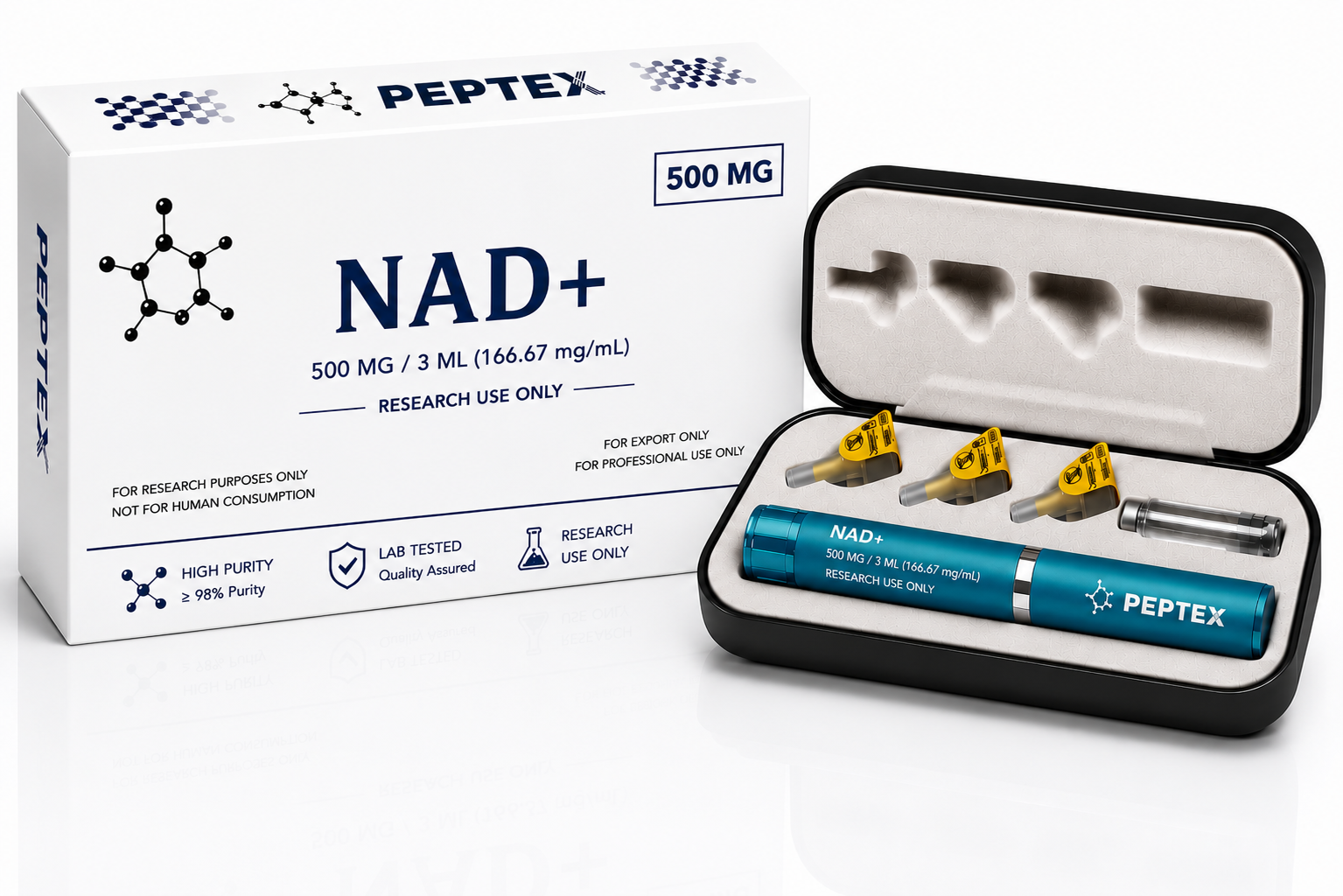
Nicotinamide adenine dinucleotide (NAD+) is a coenzyme central to cellular energy metabolism, DNA repair, and sirtuin activity. Educational protocols use 50–300 mg per administration subcutaneously, 2–3× weekly. For research and educational use only.
Quick Start
The short version
If you only read one thing, read this. The four cards below are the whole protocol in plain English — the sections that follow just add the detail.
What is it
NAD+ Pen
Nicotinamide adenine dinucleotide (NAD+) is a coenzyme central to cellular energy metabolism, DNA repair, and sirtuin activity.
Typical dose
50–300 mg subcutaneous
Start low, work up. See the phase table for a week-by-week ramp.
How often
Once weekly
Same time each day is easiest to remember and keeps levels steady.
Storage
2–8 °C, dark
Keep the mixed vial in the fridge. Powder can sit at room temp until you mix it.
Dosage Chart
Handling
Dosing & Reconstitution Guide
The pen is pre-filled — no reconstitution required. Prime the pen, dial the target mg dose, and inject slowly subcutaneously. Rapid delivery may cause a flushing sensation.
Subcutaneous Protocol
Frequency: 2–3× weekly subcutaneously. Inject slowly — rapid NAD+ delivery is associated with transient chest pressure and flushing that resolve when the rate is reduced.
Supplies Needed
NAD+ 500 mg pen
Pre-filled multi-dose pen at 166.67 mg/mL.
Pen needles
Fresh disposable pen needle each administration.
Alcohol swabs
For pen tip and injection site prep.
Refrigeration
Keep pen refrigerated when not in use.
Plain-English Glossary
Jargon, translated
A quick decoder for the terms you'll see across this page.
- Subcutaneous (subQ)
- Injected into the fatty layer just under the skin — not into muscle or vein. Easier and less painful than an IM shot.
- Reconstitution
- Mixing a dry powder with liquid (bacteriostatic water) to turn it into an injectable solution.
- Lyophilized
- Freeze-dried. The peptide arrives as a dry powder so it stays stable during shipping.
- Bacteriostatic water
- Sterile water with a tiny amount of preservative that prevents bacteria growth — used to mix peptides.
- Units (on an insulin syringe)
- The small tick marks on a U-100 syringe. 100 units = 1 mL. Most doses are just a few units.
- Half-life
- How long it takes your body to clear half of a dose. Guides how often you inject.
- Titration
- Starting low and slowly increasing the dose so your body can adjust.
Protocol Overview
- Goal: Support research on NAD+ metabolism, mitochondrial function, and longevity.
- Schedule: 2–3× weekly subcutaneous injection.
- Dose range: 50–300 mg per administration.
- Storage: Refrigerated, protected from light.
Dosing Protocol
- Start: 50 mg twice weekly.
- Titrate to 100–200 mg based on tolerability.
- Timing: Morning administration is common.
- Cycle length: 4–12 weeks in reference protocols.
Storage Instructions
- Lyophilized product: room temperature, sealed and protected from light. Refrigeration acceptable.
- Reconstituted product: 2–8 °C (35.6–46.4 °F) refrigerated, protected from light.
- Do not freeze reconstituted solution.
- Allow to reach room temperature before administration to reduce injection-site response.
Important Notes
- Use a new sterile syringe for each administration.
- Rotate injection sites (abdomen, thighs, upper arms) to reduce local irritation.
- Discard the vial if the solution becomes cloudy, discolored, or shows particulates.
- Document daily dose and site rotation for consistency.
- Slow injection reduces flushing and chest-pressure sensations.
Mechanism
How This Works
NAD+ is a redox coenzyme required by dehydrogenases across glycolysis, TCA cycle, and oxidative phosphorylation. It is also a substrate for sirtuins (SIRT1–SIRT7), PARPs (DNA repair), and CD38.
Cellular NAD+ levels decline with age; exogenous NAD+ and its precursors (NR, NMN) are studied for restoring mitochondrial function and sirtuin activity.
Potential Benefits & Side Effects
- Reported improvements in energy and cognitive metrics in longevity research.
- Support for mitochondrial function in preclinical models.
- Increased sirtuin activity supporting metabolic regulation.
- Common transient adverse effects: flushing, chest tightness, nausea — rate-dependent.
Lifestyle Factors
- Combine with resistance training to leverage mitochondrial adaptation.
- Ensure adequate B-vitamin intake supporting NAD+ synthesis pathways.
- Prioritize sleep — NAD+ oscillates with circadian rhythm.
- Limit alcohol which depletes NAD+.
Injection Technique
- 1. Attach a fresh pen needle and prime.
- 2. Clean the injection site with alcohol.
- 3. Dial the target mg dose.
- 4. Pinch a skinfold; insert at 45–90° subcutaneously.
- 5. Depress the plunger slowly to reduce flushing.
- 6. Withdraw and dispose of the pen needle in a sharps container.
Important note. This content is for educational and research purposes only and does not constitute medical advice, diagnosis, or treatment.
References
- 1
- 2
Explore more
Browse all PeptexLab protocols
Every PeptexLab reference material has a dedicated dosage protocol page with reconstitution guides, phase schedules, and research references.
View all protocols